

Open Surgery vs. Minimally Invasive Surgery: What's the Real Difference?

If you or someone you love is facing an upcoming operation, chances are you’ve already run into a few unfamiliar terms like “open surgery,” “minimally invasive,” “laparoscopic,” and “keyhole surgery.” It can feel like a lot to take in when you’re already anxious about the procedure itself.
So let’s break this down in plain language: what open surgery and minimally invasive surgery (MIS) actually are, how they differ, and why the “closing” part of the procedure matters more than most people realize.
Open Surgery: The Traditional Approach
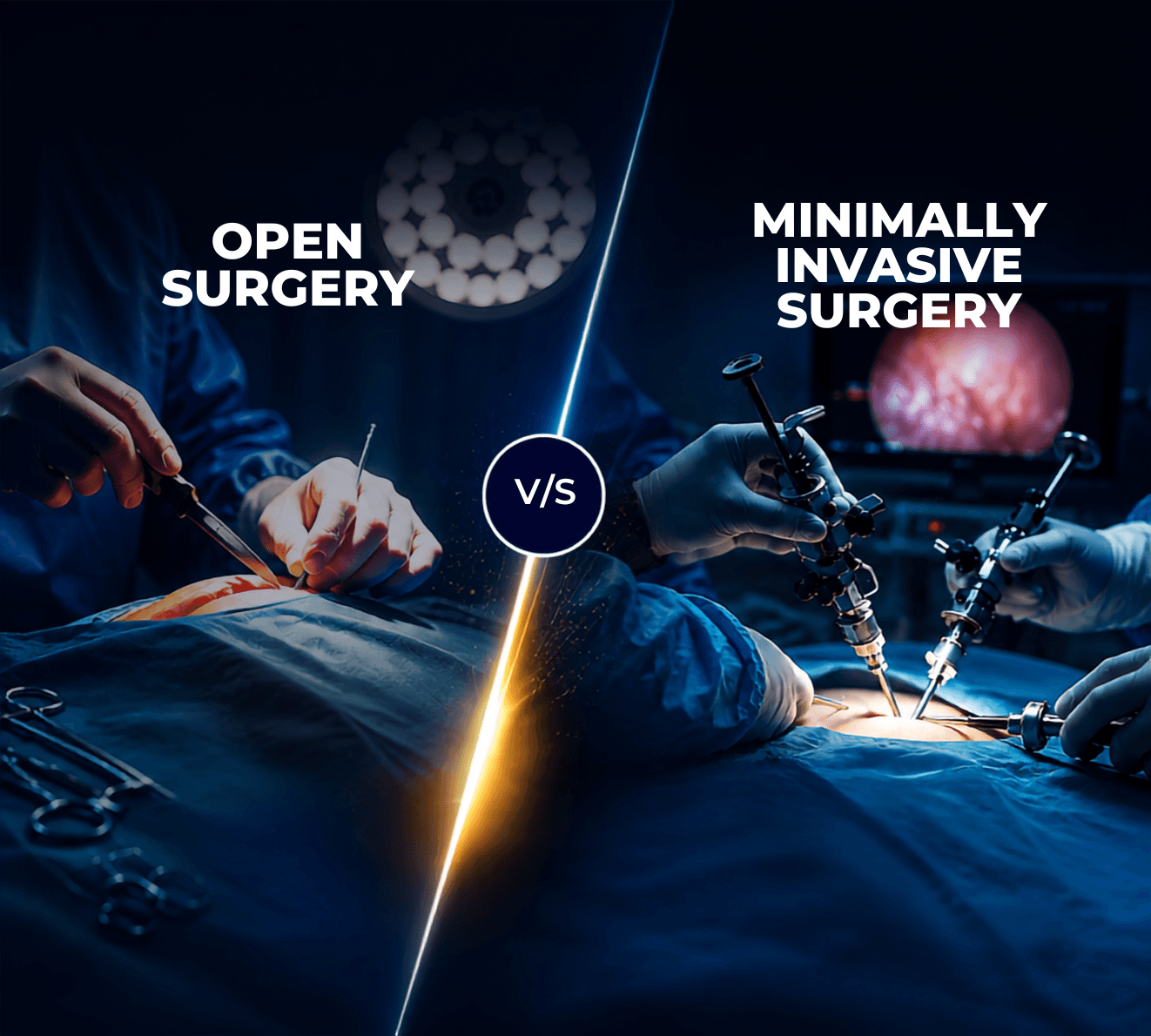
Open surgery is what most of us picture when we think of an operation. The surgeon makes a single, larger incision to gain direct access to the area needing treatment, whether that’s the abdomen, the chest, or a joint. With everything in clear view and within reach, the surgeon can use their hands and standard instruments to work directly on the tissue or organ.
This approach has been the backbone of surgery for over a century, and it’s still the right choice for many situations — especially complex, high-risk, or emergency cases where speed, direct visibility, and hands-on control matter most.
The trade-off is that a larger incision generally means more disruption of muscles and tissues, which can translate into enhanced post-operative pain, a longer hospital stay, and a longer road to full recovery. It also typically leaves a more noticeable scar.
Minimally Invasive Surgery: A Different Way In
Minimally invasive surgery takes a different path to the same destination. Instead of one large incision, the surgeon makes a few small ones, normally each less than 5-12mm. A thin camera (laparoscope) is inserted through one opening to give the surgical team a magnified, high-definition view of the area on a screen, while specialized long, slender instruments are guided through the others to perform the procedure.
Some MIS procedures are performed with robotic assistance, where the surgeon controls robotic arms with remarkable precision from a console, but the underlying principle is the same: achieve the surgical goal through the smallest possible access points.
Because there’s less disruption to the surrounding muscles and tissues, patients undergoing MIS often experience:
- Less post-operative pain
- Shorter hospital stays
- Early return to daily activities
- Smaller, less visible scars
- Lower risk of certain complications, like wound infections
That said, MIS isn’t automatically “better” for every patient or every condition. Some situations, anatomies, some tumors, and some emergencies are still best served by open surgery. The right approach depends on the specific diagnosis, the patient’s overall health, and just as importantly, the surgeon’s training and comfort with each technique. A skilled surgeon knows that the goal was never “smaller incision” for its own sake; it’s the best possible outcome for that particular patient.

Why the Closure Matters, Whichever Path Is Chosen
Here’s something that doesn’t get talked about enough outside the operating room: regardless of how the surgeon gets in, how the incision is closed has a real impact on how well and how quickly a patient heals.
In open surgery, closure often involves a layered approach — internal sutures to bring deeper tissue together, followed by sutures or staples for the skin. Staples can be a fast, reliable way to close longer incisions with even tension, which matters for how a scar ultimately looks and how well the wound holds together while it heals. Sutures, meanwhile, offer flexibility; they can be placed with precision in areas where a more delicate, customized closure is needed.
In minimally invasive surgery, the small external incisions are usually closed with fine sutures or adhesive strips, since there’s simply less to close. But the tools used inside the body during MIS- needle drivers, suturing devices, and internal staplers- still have to perform flawlessly through a tiny opening, often while a surgeon is watching a screen rather than looking directly at their hands. That demands an entirely different level of engineering precision from the products themselves.
This is exactly the space AMS lives in. Whether we’re supporting a traditional open procedure or an advanced laparoscopic one, our sutures and staples are designed to give surgeons confidence and control, because a wound that closes well is just as important as the surgery that came before it.
What This Means for Patients
If you’re preparing for surgery, here are a few honest takeaways:
- Don’t assume “minimally invasive” is always the better option for you. It’s a fantastic tool, but the right choice depends on your specific condition; trust your surgeon’s recommendation and ask them to explain their reasoning.
- Ask questions. How long will the surgery take? What’s the expected recovery time? What kind of scarring should I expect? A good surgical team will welcome these questions.
- Recovery isn’t just about the incision technique. Nutrition, movement, wound care, and following your surgeon’s post-op instructions all play a huge role in how well you heal, no matter which approach was used.
Our Commitment
At AMS, we see ourselves as partners to the surgical community, not just a supplier to it. As surgical techniques continue to evolve, we intend to keep evolving alongside them, investing in the kind of innovation that helps surgeons push the field forward, safely and confidently.
Curious about what holds it all together once the procedure is done? Read our complete guide on [Sutures vs. Surgical Staples: How to Decide What’s Best for You] to learn how each closure method impacts your healing and scarring.
This article is for general informational purposes and is not a substitute for professional medical advice. Always consult your surgeon or physician about the best surgical approach for your individual condition.